Wednesday, May 11, 2011

The Thai Lunar Calendar

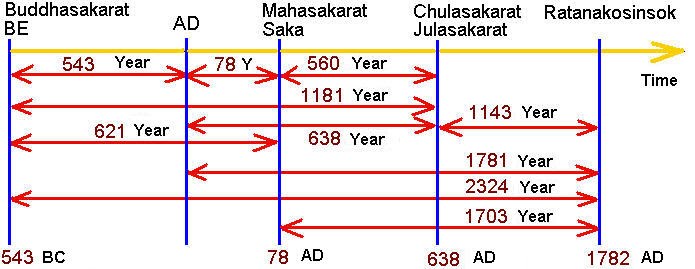
If you have ever been to Thailand, then you probably already know that the calendar here is slightly different. Here we use calendars that show the Buddhist Era. This counts the years from the time when the Lord Buddha passed into Nirvana. This predates the Christian Era by 543 years. So, even though this year is 2008 A.D., in Thailand, calendars show it as 2551 B.E. Although Thailand adopted the solar calendar system in the late 1880?s in order to synchronize with the Western calendar, the new year started on 1st April. This continued like this up until 1941 when it was changed to 1st January.

Thai calendars show both Buddhist Era and Christian Era dates. They also have another set of dates which belongs to the old system which calculates the Thai Lunar Months. This is when it gets complicated. Lunar months do not match the solar calendar. For example, although we are now in August which is the 8th month, it is in fact the 9th lunar month. So, why is important to still show the lunar calendar although it hasn’t been used officially for several hundred years? Well, all Buddhist holidays and festivals are based on the Thai lunar calendar. It tells people which day of the week is “wan phra” or the holy day and which days we should celebrate holidays such as Khao Phansa and Loy Krathong.
One of the questions we often get at ThailandQA.com Forums is when will Loy Krathong be celebrated this year or the next. This is because many of these holidays are not fixed by the solar calendar. Here are the official dates according to the lunar calendar:
Magha Puja Day – full moon day of the third lunar month
Ashana Puja Day – on the fifteenth day of the waxing moon of the eighth lunar month
Khao Phansa – on the first day of the waning moon of the eighth lunar month
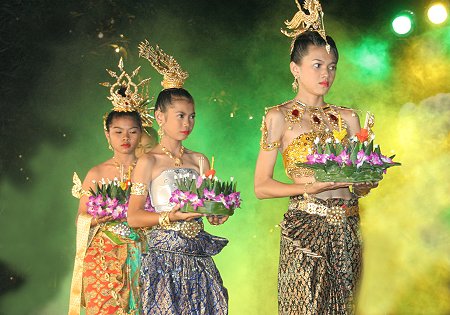
Loy Krathong – on the full moon night of the twelfth lunar month
Phra Samut Chedi Temple Fair – on the fifth day of the waning moon in the eleventh lunar month
A complete cycle of the moon, from the new moon (dark moon) to the full moon is 29 and a half days. To make up for this, months alternate between 29 days and 30 days. Like I said before, August this year is the 9th lunar month. It has 15 days of waxing moon (known in Thai as “keun”) and 14 days of waning moon (known in Thai as “raem”). Next month has an equal 15 days of waxing and 15 days of waning. For most of us, today is Thursday 21st August. But, on my lunar calendar, it is “5 raem 5 kam deuan 8?. The first “5? is for the 5th day of the week which is Thursday. Then “raem 5? is the 5th day of the waning moon. Finally, “deuan 8? translates as the 8th month. I should also mention that “kam” refers to the period starting after sunset and not the start of the day.

Let’s take a look at some of the festivals mentioned above. First an easy one. Loy Krathong is celebrated every year on the full moon night of the 12th lunar month. The 12th lunar month is usually in November though it is sometimes earlier. This year, the full moon is on 12th November 2008. In Thai this is “keun 15 kam deuan 12?. For the next example, we will take the start of the Buddhist Rains Retreat which is called Khao Phansa. This starts on the first day of the waning moon of the eighth lunar month. This year, the 8th lunar month started on 3rd July. In Thai, waning is “raem” which is the period after a full moon. This happened on 17th July and so the next day is then “raem 1 kam deuan 8?.

After a while it does become easier. You just need a Thai calendar that marks the lunar months. To find out the dates for the Buddhist festivals and Loy Krathong for next year, it is possible to buy 100 year calendars. However, be warned, they have made mistakes in their calculations before and some years we celebrate major Buddhist holidays on the wrong day!
Buddhist Era (B.E.): The official year in Thailand is counted from the death of the Buddha. The year the Buddha passed away is 0 B.E. To convert from A.D. to B.E., one can generally add 543. For example, the year 2000 A.D. would be 2543 B.E. in Thailand. Although the Buddhist Era dates are widely used, most people are aware of the Gregorian dates. In neighboring India, Sri Lanka, and Burma the date of the Buddha’s passing is counted as 1 B.E., however in Thailand, Laos, and Cambodia it is counted as 0 B.E.

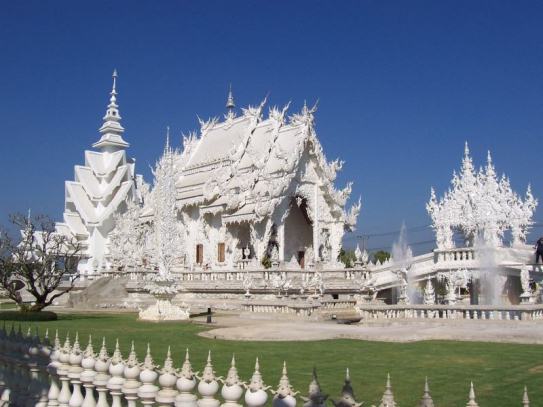
Chiang Rai: The White Temple

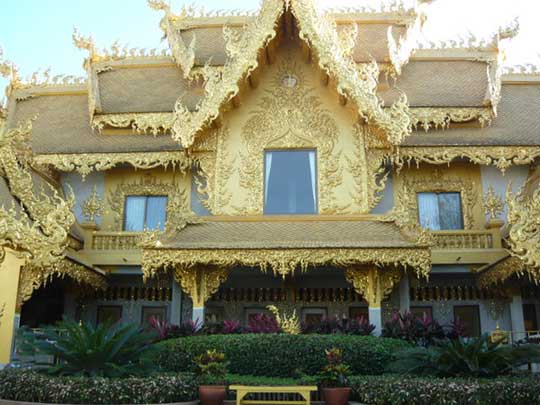
Wat Rong Khun, the stunning White Temple, its facade shimmering in the sun from thousands of tiny mirrored pieces inserted into its gleaming white surface. This temple, which is in Chiang Rai in Northern Thailand, is more well-known among foreigners as The White Temple.

The temple is located in Ban Rong Khun, about 13 kilometres south-west of Chiang Rai city along Phahonyothin Road. It is the brainchild of Thai artist Chaloemchai Khositphiphat who started building it back in 1998.In an interview, he said that “maybe in 60 to 90 years after my death will the projected be completed”.

Chaloemchai Khositphiphat, in his lifetime has become a great Contemporary Thai artist that is admired by many people. He has not only revitalized an interest in the ancient Thai murals found in temples, but he has at the same time produce his only unique style. Most obvious is the choice of white for the temple while others are golden. He said that he believes that gold is only suitable for people who lust for evil deeds.

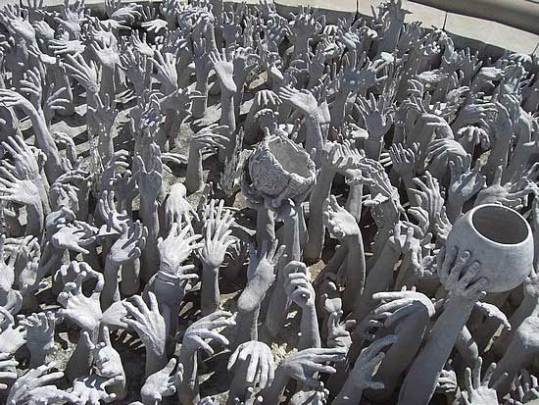
The attention to detail in the temple is remarkable and you do need to spend some time here studying the beautiful artwork. To reach the temple you have to cross a bridge over a pit of hell. Down below there are sculptures of people who are presumably trying to escape from hell. Inside the temple is a beautiful coloured mural of the Buddha. If you take a close look at the devil you will see small portraits of Bin Laden and George Bush in the Devil’s eyes. Across from the Buddha images, the artist has painted a montage of recent events, including the plane flying into the Twin Towers.

One of the new buildings is this Golden Toilet which is probably the most beautiful rest room in Thailand. Surprisingly it is also free, the same as for entry to the White Temple. Though obviously donations are welcome as up-keep of all the buildings is never-ending. You can buy reproductions of Chaloemchai’s impressive artwork in the souvenir shop. The White Temple is open daily from 8 a.m. to 6 p.m.

All Quiet at Erawan Shrine

his is the famous Erawan Shrine in Bangkok at the Ratchaprasong Intersection. Thousands of tourists and local people come to this shrine every day to pray and wish for good luck. It is always teeming with life. I have never seen it so empty as it has been… Written by: Richard Barrow Read more: All Quiet at Erawan Shrine at My Thai Photos by Richard Barrow.
bangkok-temple
History
The Erawan Shrine was built in 1956 as part of the government-owned Erawan Hotel to eliminate the bad karma believed caused by laying the foundations on the wrong date.

The hotel's construction was delayed by a series of mishaps, including cost overruns, injuries to laborers, and the loss of a shipload of Italian marble intended for the building. Furthermore, the Ratchaprasong Intersection had once been used to put criminals on public display.
bangkok_temple_dance

An astrologer advised building the shrine to counter the negative influences. The Brahma statue was designed and built by the Department of Fine Arts and enshrined on 9 November 1956. The hotel's construction thereafter proceeded without further incident. In 1987, the hotel was demolished and the site used for the Grand Hyatt Erawan Hotel
bkk-temple-1
It’s located in the middle of modern city. Hundreds of people are visiting Erawan Shrine daily, wishing for luck in business or love. They make small offerings such as food and drinks, all kinds of flowers and wooden elephants as well. Thai people offer their respect when passing the shrines. The classical Thai dancers with orchestra are arranged to perform at the Shrine quite often. There is a story of the old lady asked for help in her business, and promised to dance to the shrine, if her wisher were granted. Legend said that her business flourished and she performed as promised.
bkk-elephan

Erawan Shrine is located in central Bangkok, at the intersection of Ratchadamri Road and Ratchaprasong Road in Pathum Wan district.

Thursday, April 14, 2011

Songkran

Songkran Festival, April 12-15, is the traditional Thai New Year. This is the time for Thais to pay homage to Buddha images, clean their houses, and sprinkle water on their elders in a show of respect. Anyone who ventures out on the streets is likely to get a thorough dousing of water, all in good fun, but also quite welcome at the peak of the hot season.
The festivities at school started with a small sketch to show the students the real meaning behind Songkran. In the picture to the left, a "daughter" is sprinkling water over the hands of her "parents" in order to show respect.

Afterwards, the students lined up to pay respects to the Buddha image and then to the teachers by pouring rose scented water over their hands.

Even the teachers took part in the ceremony. During Songkran, all of the offices and schools were closed and people celebrated for almost a week in some places. Many of our students went out on the back of pick-up trucks armed with buckets of water and water guns. Others stationed themselves on strategic intersections in order to douse motorcyclists or any motorist with their windows wound down. No-one complained about getting wet as April is very hot.

In other calendars


Songkran is also celebrated in Laos (called pee mai lao), Cambodia (called Chaul Chnam Thmey, Cambodian New Year), Myanmar (called Thingyan), and by the Dai people in Yunnan, China (called Water-Splashing Festival). The same day is celebrated in South Asian calendars as well: the Assamese (called Rongali Bihu), Bengali (called Pohela Boishakh), Oriya (called Maha Visuba Sankranthi), Malayali, Punjabi, Sinhalese, and Tamil New Years fall on the same dates, based on the astrological event of the sun beginning its northward journey. And, as mentioned above, there is an Indian Festival called as Sankrant or Makar Sankranti in Marathi, celebrated every year on 14 January. Songkran as such is similar to the Indian festival of Holi, with a lot of splashing of water as paints, colored dusts, and fragances.


The traditional new year celebration in Sri Lanka also coincides with the Thai new year.
In Nepal, the official new year is celebrated on the 1st of Baisakh (Baisākh) according to astrological calendar Vikram Samwat and day often falls somewhere between 12-15 April.

It occurs at the same time as that given by Bede for festivals of Eostre—and Easter weekend occasionally coincides with Songkran (most recently 1979, 1990, and 2001, but not again until 2085).

Tuesday, May 11, 2010

Noodle Rolls with Dried Shrimp

Noodle Rolls with Dried Shrimp (guay tiew lord)
ก๋วยเตี๋ยวหลอด
This is a simple side dish that you can do as an appetizer. In the ingredients pictured below, you can see wide noodles, a mixture of chicken, tofu and garlic, bean sprouts, dried shrimp and sliced egg in the middle.
Prepare the mixture first by finely grinding cilantro root, garlic and pepper. Heat some oil in a wok and when it is hot add the mixture and cook until the garlic is nearly golden brown. Add the minced chicken and stir-fry until cooked. Next add the tofu and dried shrimp. Season with equal amounts of soya bean sauce and sweet soya sauce. Blanch the bean sprouts in hot water until soft. Beat the eggs and then fry it in a wok so that it is very thin. Roll it up and then slice the egg thinly so that it looks shredded. Put a spoonful of the mixture, together with the bean sprouts and egg, onto the wide noodle and roll it up. Use a sharp knife to cut across the roll without going through to the other side.